

This post has been circulating, so I thought I might like to write a rather unpopular post about it that will generally be liked by nobody.
I do always prefer my posts to be liked by at least some people. But occasionally, when I’ve been buried away in my little work bubble and a bit disconnected from the going-ons of humanity, I’ll come back for a moment and say something that almost nobody likes.
I suppose this has something to do with the sort of mode of thinking that technical work requires. It certainly it not a very convivial mode of thinking.
Call my lack of reservation in saying the thing a vice. Or a virtue. Whatever it is, I’ll say it. Because someone ought to sometimes, and I suppose I’m that guy.
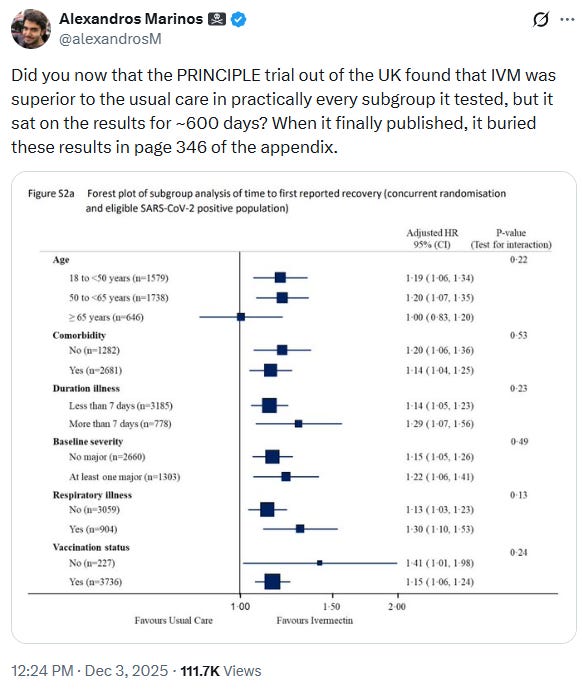
Why was this figure posted from Mr. Marinos buried in the appendix of the PRINCIPLE study? Was it a conspiracy? Are we trying to hide from The People the truth that Ivermectin does, in fact, work?
It’s a bit simpler than that. And the implications are rather important.
Let’s cut to it.
The figure was buried because this study was not double-blinded: every patient knew if they were receiving the drug or not.
People who received the drug reported that they perceived that they recovered more quickly. They would do the same if you gave them sand and told them it was magical healing dust.
And importantly, none of the hard endpoints were improved by Ivermectin.
So:
The patients knew whether they were given Ivermectin or placebo;
They were asked to provide a subjective account about how fast they recovered;
The actual hard clinical outcomes that were objective showed no difference.
That, my friends, suspiciously resembles a classic placebo effect.
Now, the commentary about why this is important. A rant, perhaps, one might say, if you will forgive me.
None of this is not to say that Ivermectin does not work. The problem is a bit deeper than that.
All of this is just to say that a specific aspect of study design makes it impossible to interpret these results as clear evidence that it does.
Let’s flesh that out a bit more.
If you threw out methodological considerations like these, you would end up concluding that everything works, including the much acclaimed snake oil, but also genuinely harmful drugs.
And that’s a problem.
And people would at minimum be exploited and at worst genuinely harmed.
The best explanation for why this finding was shoved into the appendix for this paper is that the scientists who ran the study were scientists.
The more concerning thing about pandemic science during the early years is that these sorts of methodological considerations were thrown out when it came to FAVORED interventions like lockdowns, masks, etc., yet they were more strongly insisted upon for DISFAVORED ones, like Ivermectin.
There were, in short, scientific double standards when it came to policy recommendations.
These double standards were systemic: public health policy was politicized in ways the benefited government and corporate bureaucracies—not the public.
In short: “Scientific rigor for thee, but not for me. (Because I have power by laundering the credibility of the institutions. And you, my friend, do not.)”
The bottom line is that if you say that this finding demonstrates the effectiveness of Ivermectin—and it being buried in the appendix suggests a conspiracy—you’re also forced to say, if you’re being consistent, that lockdowns, masks, school closures, etc. saved millions of lives through similar other sorts of flawed studies.
And you’ll be forced to say, yes, that sand, which we are going to tell people is magical healing dust—it works for Covid too. (Not to mention the ~hundred other bizarre tinctures that were once touted as possible Covid cures.)
And we’re right back to where we started two thousand years ago, and scientific medicine does not exist.
That’s not a state of affairs that anyone wants. It is in fact quite a dangerous one, and medicine becomes completely untrustworthy.
We’ve already seen some of that. But only some.
But if you want to pursue this line of thinking to its limit—well, if you think things are bad now, trust me, things can still get much worse.
That’s why scientists don’t call throwing this figure into an appendix a conspiracy.
It commits them to far more dangerous positions.
Now scientists just need to take the same responsibility about the sorts of interventions they pushed early on in the pandemic with similarly shoddy evidence.
Or other sorts of interventions in many fields that are turning out to be harmful or will in the future—but wouldn’t have had scientists done the very simple things we were all trained to do, followed the very simple sets of rules that we all know make for reliable science.
Of course they won’t.
And they may even punish those who do.
Because the present way that our scientific institutions are organized does not require scientists to take responsibility for anything except covering their asses and staying silent during the latest, ever-changing scientific or political hysteria.
Ah well. What can you do.
There ya go. A short, unpopular post.
A bit curmudgeonly, I’d say. Some days ya gotta curmudgeon.
THIS is the honesty and transparency I have been looking for!
And it fits with my own sense about it.
All of it!
Thank you!
great points, but at this late date, is it more important to look to Ivermectin to kill some of the (turbo) cancers the death jabs have caused in people? There are likely more studies on how ivermectin has cleared or slowed cancerous tumors than there are anecdotal reports of the patriotic renegade doctors who chose to treat patients who had "COVID" infections with Ivermectin and a few other drugs to achieve recovery. Perhaps you might contact Joe Rogan and address a larger audience as you have some important things to tell a much wider audience Dr Kevin. Your story alone deserves a wider audience for certain.