

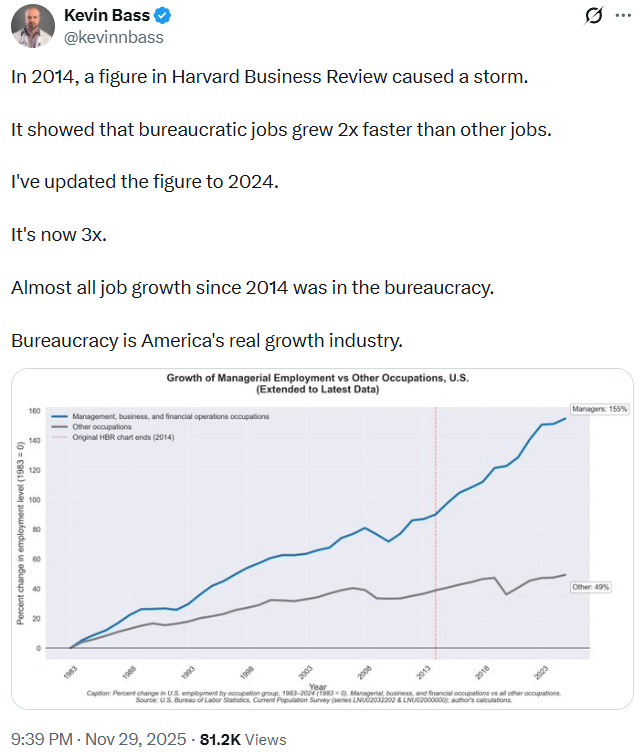
I created the above figure, and it stirred some interest. In this post I want to explain why this is happening.
Bureaucracy expands endlessly because of affluence + organization size + depoliticization and the lack of any force that can really discipline institutions.
Poor, small, and fragile: “If we don’t build, we die.” Big downside to not building.
Rich, big, and stable: “If we screw up, we could lose what we have.” Big downside to instability and risk.
So big institutions are punished more for mistakes than for stagnation. Big institutions can’t really die, but the managers can get punished. So managers optimize for not getting punished, not for dynamism.
They add rules, committees, safeguards, etc. to prevent mistakes that they can be punished for—which is to say, anything that looks risky or uncomfortable, involves open conflict, etc.
Over time you need whole classes of people whose job is to prevent mistakes—that is, to smooth discomfort, reduce risk, and manage conflict. Think ever-expanding HR, DEI, compliance, endless new offices to reduce risk, and regulatory frameworks at a national or global scale.
AI, nuclear bombs, nuclear energy, environmental damage, fossil fuels, pandemics, chemicals in food and water, racism, sexism, homophobia, transphobia, Islamophobia, and so on are all framed as problems to be fixed by adding more bureaucratic layers, more programs, more officials, more offices, etc.
That’s not to say these problems aren’t real. Many are. But big institutions address them according to their own survival logic, not a coherent emancipatory project. The core aim is always to reduce risk and discomfort inside big rich organizations, and the tool is always more rules, more procedures, more bureaucracy.
And once you add bureaucracy, it’s almost impossible to get rid of it. “Don’t you care about children/women/health/people dying/people being poisoned/fairness/etc.?”
You also end up with institutions that cannot adapt quickly or respond effectively to crisis or large-scale change, since they have selected that capability out. Remember that dynamism is dangerous for managers: large downside, low personal upside. So institutions lose adaptive capacity over time and harden in more procedure and departments, narrowing know-how, and leadership cohorts that are trained in risk aversion rather than transformation.
Large rich institutions thus move very slowly and reactively self-protect. And since they all share the same underlying logic and training, when they finally move, they often move all at once, together. Being an outlier increases risk, so you had better move when everyone else does.
After inaction, this in turn can lead to dramatic overreach. This tendency ends up shredding credibility in both directions—for not doing enough when it was required and for doing too much when it was not required.
Increasing censorship and control of media and social media to prevent a legitimacy crisis becomes tempting. Criticism is called misinformation. Often it really is misinformation; it’s false. But it reflects real frustration, and both true and false criticism thus become subject to censorship. Almost perfected in China, growing rapidly in Europe, at a standoff in America, this becomes one of the self-protective shells of ever-expanding big rich org modern regimes.
Without some countervailing discipline, the bureaucracies keep growing, consuming larger and larger chunks of the economy. But it’s not just the economy. Over time, big rich org logic colonizes culture, politics, and science. Big change is scary in big rich societies for the same reason it is in big rich institutions: too much downside.
So, political, cultural, and scientific contestation becomes forbidden or taboo on many key questions. Don’t cause risk or discomfort. Remember that big rich org logic is to reduce risk and discomfort. Therefore increasing risk and discomfort goes against this dominant logic. Forms of political, cultural, and scientific contestation (“free speech”) that do this are heavily disincentivized.
Experts who exemplify the institutional logic reduce politics and science to “The Science”. The Science is really just big rich org risk-averse logic that has colonized every scientific, scholarly, and political field. The Science thus essentially fuses science and politics into a hybrid that borrows legitimate parts from both but is, in a strict sense, neither.
Journalism, publishing, media, etc. all undergo the same transformation and are reshaped by the same big rich org logic.
Modern progress is conceived as more fairness, more safety, more comfort, less risk, for larger numbers of groups, as implemented by the ever-expanding bureaucracy.
Every political arrangement has an ideology that legitimizes it, and in the modern, post-scarcity, large-institution West, that’s progressivism. Classical liberalism is the legitimizing ideology of the pre-managerial, small-scale capitalist order (which ended in the 1930s–60s); remnants of classical liberalism dominate among small entrepreneurs, tech bros, etc. Evangelicalism and right-wing populism are dominant among those who work outside the big institutions and oppose them. And so on.
Progressivism—the mainstream institutional left—is thus big institution + affluence ideology—the ideology of big, rich, risk-averse institutions. It’s not really Marcuse or Marx or any particular philosopher, religion, or ethnic group; it simply is the worldview of people who live inside large, comfortable organizations. It is not “ideological capture”. It is “ideological essence” of the underlying economic-organizational form.
As institutional capacity declines and dysfunction increases, the ideology of the institutions—progressivism—radicalizes. The pie is stagnant or shrinking, criticism rises, the American dream is seen as having a big rich org job, and so the masses go to college to chase it, and competition inside big rich orgs intensifies as everyone fights over a limited number of comfortable big org jobs.
Policies—more bureaucracy—are set up to adjudicate this intensifying internal competition. That’s where affirmative action, DEI, etc. come from.
These policies are not purely top-down. Big rich societies mass-produce people whose job is to work with words, rules, and feelings rather than to build. Schools, media, universities, nonprofits, etc. all communicate that meaning and status come from “impact” and “justice”. But when people enter these institutions, there is no real frontier or growth story. One of the cheapest paths to career movement therefore is grievance and moral accusation, or facilitating it.
Pressure builds from below. It began with mass enrollment in universities in the 1960s and has only intensified since.
In big, rich, risk-averse institutions under current conditions, DEI is destiny. Its name may change, but it cannot be excised while keeping everything else the same. In practice, the existing order never fundamentally changes its own incentives or myths on purpose. That takes crisis or rival institutions built on a different logic.
We can test this easily through a cross-country comparison. In East Asia the big rich org keywords are “harmony” and “social stability” instead of “DEI” and “safety”. But this is the same reflex: suppress conflict, minimize risk, and justify a growing bureaucracy as the guardian of social and institutional order.
In America, the form of conflict to be minimized is framed along racial lines. In East Asia, the framework is more traditionally Confucian: hierarchy, seniority, “wa” (harmony), not embarrassing the group. The locally determined background ideology matters. But, same form, different flavor.
Look at a large Japanese firm or ministry: endless consensus meetings, documents that need thirty stamps, whole “compliance” and “power harassment” offices that exist to manage workplace friction and protect the institution’s image. They don’t talk about “equity and inclusion,” but the function is identical to an American DEI/HR office suite: turn every conflict into a process, absorb it in paperwork, and make sure no one ever has to take clear personal responsibility.
To purge identity politics from the American institutions would really mean to purge identity politics from the basic political grammar of American life and replace it with something else. This cannot be done by fiat by the executive. And even if it could, the same big-org risk-averse logic would simply metamorphose into a new moral language. DEI is just the American accent of a global bureaucratic language whose grammar is risk-avoidance and conflict-suppression.
Everyone is afraid to steer this leviathan because steering is seen as risky and destabilizing; indeed, it violates big rich org logic of minimizing disruption and risk. It’s a soft taboo. A kind of secular evil. Everyone is terrified of both action and inaction. Debt climbs, crisis builds, it becomes next to impossible to do really big projects, and almost nobody wants to take real responsibility for steering.
You are here. The only way out is to design institutions that reward responsibility and risk-taking, not manage decline.
I've always found it interesting that conservatives often are the ones complaining about over-large beauracracies, especially in government, but basically never do anything about it. I think it is because conservatives are also more resistant to large-scale change. This is why so many supposedly 'small-government' conservatives did nothing but complain about things like DOGE. I wrote about this idea here: https://open.substack.com/pub/moralstructure/p/the-conservative-dilemma?r=hnzyk&utm_campaign=post&utm_medium=web&showWelcomeOnShare=true
It’s a hard problem. We know from psychological studies that humans are more strongly motivated by risk avoidance than by potential gain. Evolution all but guarantees that — better to have one fewer offspring than to die and have none.