

In writing this post, I kept stumbling across the books and articles of a prominent scholar of pre-Socratic philosophy, one Charles Kahn in the Department of Philosophy at the University of Pennsylvania. I remember Dr. Kahn. A couple years after graduating from the University of Texas at Austin, I spent several years pottering around the Philosophy Department at Penn, seriously considering whether to pursue a career as a philosopher and classicist. The Greek philosophers mesmerized me, and I audited a series of courses in the field. I even learned how to read classical Greek, the language in which classical Greek philosophy was written.
As I wrote this essay, I was reminded of a couple of conversations that I had with Dr. Kahn that impacted the course of my life. One, after being assigned to write an essay on Aristotle’s concept of phantasia, I expressed my difficulty to him in my writing an essay on such an obscure concept with no apparent practical purpose. (Given my enormous respect for the man, I think I said it to him quite a bit more delicately, but my meaning was the same.) I told him that I was thinking about going into medicine instead. He shot back, “Then do medicine! Make philosophy a hobby. Don’t go on a wild goose chase.” He didn’t say it in a harsh way, and he was not offended. He was trying to be helpful. I was almost overcome with the lack of egotism in his response: unlike many other academics who would have advised me differently, he didn’t want me to become a clone of him. He wanted me to do what suited me. Having that conversation with him moved me deeply. I took his words to heart and shortly after began studying for the MCAT, taking seriously the possibility of a career in medicine for the first time. I scored in the 99th percentile. Alas, today a profession in medicine seems a long way off indeed.
So I have returned, in a way, to ancient Greece. Still as a hobby—and this time, I hope, with some practical purpose. Because I remember another exchange that I participated in with Dr. Kahn during a graduate seminar about Aristotle. One graduate student presented their paper, focusing on a concept in Aristotle’s thought that Heidegger had used to construct an etymology to highlight an important philosophical. Heidegger is one of the most important and influential philosophers of all time. The student pointed out that Heidegger had constructed a false etymology, and that the relationship between the words used in ancient Greek that Heidegger had wanted to highlight was not a real linguistic relationship. After a lengthy discussion about the details of the relevant words in classical Greek, I remember Dr. Kahn concluding with something along the lines of, “Well, Heidegger may have gotten that point wrong, but it was an exciting and thought-provoking error to make, and that’s the real point of what we are doing, isn’t it?”
Dr. Kahn’s words were refreshing to me, and I remember them well. As an extremely rigorous and respected scholar, his point was that philosophy is supposed to be about the fruits it bears, not always necessarily quibbling about every detail. He wanted people, especially young people, to be excited about thinking.
There are many debates that take place among classical historians about the points that I will be making below. Debates on the finer points of interpretation that go deep into the sources and extend for dozens of pages. But the main purpose is to have us think—in this case about pressing issues about the status of science that confront us in the present day.
To be blunt, my purpose here is to defend science against those who today seek to destroy it. My purpose is to build fortifications, defenses, and weapons against those who pillage science in the name of science. And the only possibility for doing so is to understand what, exactly, is the nature of that threat, so that we can build the antidote to neutralize it. Thus I start with the origins of that threat—at the origins of science itself.
If I have gotten any of the details wrong, I would be glad to hear about them—because a defense based on false premises is a poor one.
As always, if you enjoy what you read, please consider becoming a paid subscriber. If you are already a paid subscriber, please consider making a comment or clicking “like”. Knowing that my work is appreciated is important for me to keep writing.
According to a once widespread belief, the millennia-long battle of scientists against superstition and prejudice had been won. Nearly every aspect of everyday life—and correspondingly, the entire modern economy—has been transformed by the discoveries made by scientists. Annually, trillions of dollars of taxpayer money and private R&D funding support the scientific enterprise.
But a belief in the triumph of science is becoming less tenable by the hour. The proliferation of increasingly widely held views questioning climate science, vaccines, public health policy, biotechnology, evolutionary theory, and more call this view into question.

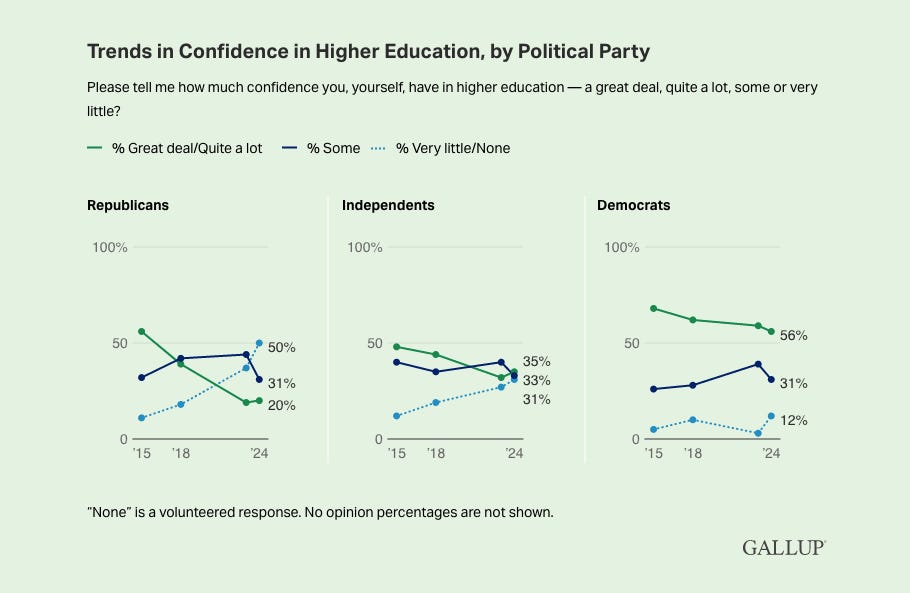
We are witnessing a collapse of public faith in scientific institutions—and academic institutions more broadly—jeopardizing the financial support that they rely on to continue producing advances that will push humankind beyond its known horizon and into its future.
This collapse in public faith has an unmistakable political dimension. Polling shows that those with beliefs on the political right have shown the most dramatic declines. Meanwhile, much more modest—if any—declines are seen among those on the political left.
To muddy the waters, the varied explanations most commonly provided to explain this are themselves strongly partisan.
From the political left, we hear that scientific misinformation is being promoted by opportunist, sensationalist right-wing social media influencers, leading their followers—who tend to have less formal education, and who therefore tend to lack scientific literacy—into increasingly stark science skepticism and even downright denial. According to this story, the catastrophic decline in public faith in America’s premier scientific institutions is being driven by bad actors on social media who sow doubt for personal and political gain.
From the political right, we hear the exact opposite: actually, they say, scientific misinformation is coming from the scientific institutions themselves, captured, as they are, by left-wing and special interests, who twist and torture the available evidence into whatever narrative that these interests demand. And it is only critics on the right and center who are getting the “truth” right.
The framing from both left and right is superficial and wrong. To understand why requires a deeper analysis.
We turn to history.
Using history as our guide to the present provides us with several distinct advantages. First, history is distant from the present, making it easier to view the world of the past with more objectivity—less partisanship—than we can the present. Second, history provides us with a broad, scoping view, taking in many years at once, helping us to avoid getting stuck in minutiae. Finally, history provides us with thousands of years of repeating patterns, increasing the confidence we can have in our inferences about how the phenomena in which we are interested really function, unbounded by particular historical circumstances.
For, the public opposition to science that we are witnessing today is not without historical precedent—nor is it quite so simple as a “decline in trust in science”. The public opposition to science is in fact as old as science itself. And all stories, as they say, have at least two sides.
At the very origins of science that we find not just public resistance to scientific thinking—but a full-blown hysterical reaction to it, widespread public moral condemnation levied against its leading figures, strict laws passed against the fields that were making most rapid progress, and, most shockingly of all, the exile and execution of most of the day’s leading scientific minds.
The result was a crushing of the scientific spirit that was only revived a full two thousand years later.
We begin, in short, by telling the untold history of scientific repression in ancient Greece. Or, what amounts to the same thing, the untold history of scientific misinformation.
As schoolchildren, we are taught that Socrates was put to death by an otherwise enlightened and rational “open society”. We are taught that it was a “gaffe”, an exception that blackens the reputation of Athens but should not fundamentally change the glowing reputation of that illustrious city-state’s radical democratic institutions. Socrates’s execution had nothing to do with the Athenian democracy—it simply was “some kind of mistake”.
This understanding is dangerously wrong. While it is true that Greece and the Athenian system in particular produced an unparalleled rate of scientific and intellectual progress, these advances also provoked a brutal, violent populist reaction that would end the Athenian scientific experiment nearly as soon as it had begun.
European classical scholars, growing up in the WW2 and post-WW2 eras and rightly disgusted by Nazi and communist totalitarianism, whitewashed this history. By selectively reading the ancient texts, emphasizing some facts and ignoring others, these scholars turned Athenian democracy—and by extension democracy itself—into an idealized myth. This idealized myth, unlike Nazism or communism, was free and open. Democracy could therefore do no harm to science or any other form of free thought.
It is understandable why these scholars did this. The Europeans saw firsthand the catastrophic consequences of the world’s two totalitarian ideologies, and they wanted to do their part in guarding against them and pointing as insistently as they could toward a different kind of future, even if that meant suppressing a dark and brutal truth.
Possibly, they secretly hoped that later generations would discover the truth once the threat of totalitarianism had passed. Discovering this truth is not challenging today, because that truth is now becoming incessant: when the truth is refused as a gift, it eventually returns by force. The time has come to learn a new lesson about ancient Athens. As public support for science in the West collapses, continuing to distort the facts and remaining naive to reality places science—and therefore humanity itself—in great danger.
Athens is not just a model—it is a warning.
We mustn’t ignore it any longer.
***
Almost immediately after the introduction of the alphabet into ancient Greece, the Greek poets Homer and Hesiod put to papyrus the region’s longstanding oral traditions of mythology, explaining all phenomena in the natural and human worlds by reference to the ongoing drama of violently unpredictable—and sometimes helpful—human-like but superhuman gods.
For ordinary Greeks, at any time, without warning or explanation, earthquake, flood, storm, drought, famine, disease, murder, or war could lead to helplessness, injury, incapacitation, or even an early death. Anxiety and terror chronically afflicted them—just as it did most prehistoric and early historic peoples.
They did what they could to make the terrifying aspects of existence tolerable: they invented explanations. The explanations were that human-like but extremely powerful beings caused everything that happened in the world.
From Chaos came forth Erebus and black Night (Nyx);
but of Night (Nyx) were born Aether and Day (Hemera),
whom she conceived and bare from union in love with Erebus.
Also she bare the Destinies and ruthless avenging Fates (Moirai),
Clotho and Lachesis and Atropos, who give mortals their share
of good and evil.
And again, the goddess murky Night (Nyx), though she lay with none,
bare Nemesis, to afflict mortal men,
and after her, Deceit and Friendship and hateful Age
and hard-hearted Strife (Eris).
Hesiod, Theogony, lines 123-125, 217-225
And because these beings—the gods—were human-like, they respond to human calls for help.
These were the first religious rituals, animal sacrifices, and so on.
Bring your sacrifices to the gods duly and fittingly
and burn sleek thighs of the rich victim;
also in holy festivals and at the new moon.
Then the gods will be gracious to you
and will give you a just share.
Hesiod, Works and Days, lines 336-341
Furthermore, humans are afflicted not just by the natural world, but by their fellow man.
Therefore the gods were moral gods—and they avenged this injustice:
But abhorred Strife (Eris) bare painful Toil and Forgetfulness
and Famine and tearful Sorrows,
Fights and Battles and Murders and Manslaughters,
Quarrels, Lies, Stories, Disputes, Lawlessness
and Ruin, all of one nature,
and Oath (Horkos), which most afflicts men on earth
when anyone willfully swears a false oath.
Hesiod, Theogony, lines 226-232
Suddenly, humans were not alone in a world of heartbreak, chaos, and death. In fact, it all had an explanation that was reasonable, and the gods would hear the humans out. In this way, all around the world, the gods, religious rituals, morality, and ancient mythology were born and transmitted down the generations.
This occurred orally, which is why the earliest Greek literature is entirely poetry; prose was only invented later. This is because oral transmission of this knowledge took the form of an oral performance, with a rhythm and cadence, accompanied by music.
This oral tradition, passed down generation by generation and evolving organically along the way, would provide the framework through which individual and community life were to be understood and conducted.
Uncertainty and complexity were distilled into simple concepts that provided comfort—both individually and collectively—in the face of conflict and catastrophe.
But it wasn’t long until Greece produced its first critics.
Less than a century after Homer and Hesiod put quill to papyrus, the world’s first skeptics shot back.
In passages that would have scandalized contemporaries, the 6th century BCE satirical poet and critic Xenophanes ridiculed the traditional beliefs for projecting onto the gods the characteristics of the people who invented them:
Homer and Hesiod have ascribed to the gods all things that are a shame and a disgrace among mortals, stealings and adulteries and deceivings of one another. Mortals deem that the gods are begotten as they are, and have clothes like theirs, and voice and form. Yes, and if oxen and horses or lions had hands, and could paint with their hands, and produce works of art as men do, horses would paint the forms of the gods like horses, and oxen like oxen, and make their bodies in the image of their several kinds. The Ethiopians make their gods black and snub-nosed; the Thracians say theirs have blue eyes and red hair.
Xenophanes, Fragments 11, 14-16
The Richard Dawkinses of ancient Greece, these thinkers asserted that not gods but abstract natural forces governed the world, prefiguring the concept of natural laws that would later come to define the natural sciences.
These thinkers would go on to elaborate complex godless systems of physical forces that gave rise to and set in motion the natural world.
The fragments of Anaximenes exemplified this approach.
Writing on the formation of the planets, for instance, he wrote:
The heavenly bodies arise as a circle of fire which is separated off from the [primeval] fire in the world, and enveloped by air.
Something capable of generating Hot and Cold was separated off from the eternal [Boundless] in the formation of this world, and a sphere of fire from this source grew around the air about the earth like bark around a tree. When this sphere was torn off and closed up into certain circles, the sun and moon and stars came into being.
The heavens are formed from a mixture of hot and cold.
The heavenly bodies are wheel-like, compressed masses of air filled with fire, which exhale flames from an orifice at one point.
Anaximenes, Fragments 5, 14, and 16
All of the early accounts were similar.
While imaginative, these accounts were completely wrong. What is also clear is that such imaginative explanations were strikingly reminiscent of the fanciful myths they sought to replace. They were, in a word, myths about the world that simply replaced gods with new kinds of entities to create similarly fanciful stories.
From this perspective, we can go further and understand modern scientific explanations of the world simply as a new kind of myth—having the same basic narrative structure as ancient myths (including these new ones), but consistent with currently existing empirical evidence. That is, we can think of scientific explanations of the world as myths about the world that are more true than the myths that came before them.
That is, there is nothing fundamentally different about modern scientific stories and ancient myths, except that modern scientific stories are based on observation and evidence.
The radical views of these early thinkers provoked a visceral negative response in ordinary Greeks. As we have seen, religious myths had been built to protect ordinary people: to make all that was unfamiliar and terrible, familiar and manageable. These new thinkers were therefore proposing to destroy and replace such comforting stories with cold abstractions, tearing away the shroud of protection that mythology had until now promised. These abstractions served the same function that the gods did—they explained—but with one difference: the new explanations did not involve human-like entities. Such beings did not model virtue; they did not avenge injustice; and they could not be appealed to for help.
If these new ideas were accepted, the world would would once again become a place of primordial chaos, intolerable anxiety, unpredictable threat, and meaningless terror.
The pre-Socratic philosophers were therefore viewed with great suspicion, even hostility, for promoting these views—which threatened to deprive the world of all known meaning.
These new accounts of the world therefore constituted among the first instances in history of what today is called “harmful scientific misinformation”, for 1) they made claims that were psychologically harmful and disrupted the community life of ordinary Greeks; 2) they made claims that purported to be factual and scientific; 3) the made claims that were not based on any evidence and were not empirically superior to the beliefs they challenged; and 4) they were plainly wrong on very nearly every point and detail.
Why participate in the religious ritual that bound the community together if the gods were not real—and coming together of the community on religious grounds was based on a false pretense? Indeed, why behave in an honorable, upstanding way—why avoid hubris or even murder—if the gods did not model or reward or punish good and bad behavior? Secular humanism had not been developed as a rationale to replace the gods—nor had any secular moral justification—so that could not be appealed to, either.
It is not that these ideas would be proven right at some later day, either. The large bulk of the ideas of this cohort of intellectuals were in contradiction with each other, and would never be proven correct.
Thus, from a modern point of view, ordinary Greeks were right to be upset: these new pseudoscientific thinkers were spreading misinformation that threatened to cause the collapse of public faith in the gods—a foundational source of support for the mental health of ordinary Greeks. Their views even threatened public order and morality.
These ideas were dangerous, wrong, and a public menace.
And it is completely understandable by modern standards—not to mention Greek ones—that they should be treated as such.
This volatile, potentially toxic stew in Greek intellectual life—that would boil over just centuries later—gets thicker still.
Because these beliefs also divided Greeks along class lines.
These thinkers were one or the other of: a) born into wealth, b) supported by wealthy patrons, c) supported as tutors of the wealthy, or d) supported by a community of enthusiastic supporters.
Surrounded by wealth and insulated from the world of ordinary Greeks, these thinkers were protected from many of the anxieties that were so conducive to religious belief.
But they also inhabited a proverbial ivory tower. Their very existence seemed to suggest: I am above this. In fact, I have much to teach you.
They knew it. They were proud of it.
Their fellow Greeks knew it too.
For all this, these ideas were seen as not just outrageous and potentially subversive—they were resented.
Yet this class division also shielded these purveyors of harmful pseudoscience from public wrath.
At the time, these wicked writers were a very select group. Literacy in ancient Greece was very uncommon, and this was especially true in the 6th century BCE. Therefore, the Greek public—or Demos—was in general not being exposed to this vile misinformation.
This would soon change—and with deadly consequences.
In a foreshadowing of what was to come, Pythagoras, one of Greece’s most influential early thinkers, would challenge orthodox religious thinking and practices through his unusual ideas. Most of these beliefs, like those of his contemporaries, were outstandingly wrong and unsupported by any evidence whatsoever. They were, in short, yet more misinformation.
To take just a couple of examples, Pythagoras believed in the concept of the "harmony of the spheres," which posited that the planets and stars moved according to mathematical equations, producing a symphony of music that was inaudible to the human ear. He also taught that the cosmos existed in a state of dualism, whereby opposing pairs (such as limit and unlimited, odd and even, light and darkness) played a crucial role in the structure of reality.
Yet his geometrical ideas had enduring influence on Euclid and Archimedes. His ideas prefigured and had a foundational influence on mathematics and natural science, especially geometry, physics, and astronomy.
Copernicus, inspired by Pythagoras, built his revolutionary system of astronomy on such principles of mathematical regularity, naming his system Astronomia Pythagorica. Newton, Kepler, and Einstein were each following Pythagorean principles when they searched for and found the mathematical unity underlying material reality. Einstein won a Nobel Prize. Newton and Kepler both would have won that same Prize had they been alive to be nominated for it.
Thus, almost as if by chance, coming out of his endless firehouse of misinformation, Pythagoras had in fact gotten a few things right. What he got wrong has entirely faded from Western scientific consciousness. But what he got right would change the course of scientific history.
Was Pythagoras, therefore, really a promoter of misinformation? And should he be impugned on that account? If his ideas threatened to undermine Greek community and moral life, was the tradeoff—giving rise to modern physics—worth it?
We can only ask these questions in hindsight. We are only aware that these are legitimate questions with the knowledge that we have today of the history of science. Ordinary Greeks—and a great many pious Greek elites, too—would have never been able to predict that outcome. Many listened to Pythagoras and his contemporaries and concluded that the doctrines they taught seemed to spew forth as if from a firehose of nonsense. Indeed, that is how many modern people today, rightly, would see things too.
Even Pythagoras’s philosophical doctrines about the underlying mathematical regularity of the universe that would go on to so influence Kepler, Newton, and Einstein—even these doctrines were not based on any evidence and would therefore constitute misinformation. Not even that, they were a kind of fake news: a complete fabrication, the lowest form of misinformation possible. Pythagoras might as well have come up with these fabrications in the shower, as many promoters of misinformation seem to today. To be sure, being a Greek, the fabrication would have been done, perhaps, in a bath.
No doubt, skeptics in the day of Pythagoras would declaim at Pythagoras, “This is an outrageous claim; it is at odds with overwhelming consensus; and it is no based on any evidence whatsoever!” We can imagine such a thing being tweeted today. And that ancient Greek equivalent of a proverbial Karen with a PhD on Twitter would, in their own way, be right.
She would be absolutely right.
Therefore, we can say that, pieces of rubble from amidst a great pile of misinformation would profoundly influence, time and again over the course of science, and give rise to the magnificent achievements of modern physics and cosmology.
A tricky, uncomfortable, and remarkable proposition, this has profound implications for how we understand both science and misinformation.
The problem is deeper than that. The problem indeed goes several layers deeper. We will examine just one of these layers. For we have still only seen one side of this story.
Views like those of Pythagoras and others of these thinkers were a part of an overall tendency of Greek rationality that was penetrating the consciousness of the whole class of the educated Greek elites with whom they were associating. Systematic, rational thinking discarded traditional considerations and led to remarkably rapid developments in Greek art, theater, architecture, warfare, commerce, science, and more. Indeed, such rational thinking revolutionized statecraft itself and, in rejecting tradition and replacing it with rational planning, made possible the development of new forms of social and political organization, in the form of thriving Greek metropolitan cities.
What was once the provenance of the epic myths of the gods became progressively overtaken by a prolifically creative abstract rationality: a global shift toward a “secularizing” mental framework that entrepreneurial Greeks came to apply to important problems of the day in art, science, and technology.
In other words, the pre-Socratic philosophers, in constructing these fantastical accounts of reality, were doing nothing more than legitimating an emerging framework through which many Greeks were collectively coming to view the world. In trying to systematically explain the world via rational speculations—rather than an appeal to the divine—the pre-Socratics were rationalizing and legitimating the perspective of their fellow, highly educated Greeks. This segment of Greek society felt deep in its bones that the explanations for the universe set down by traditional mythology must be wrong, and they craved alternative accounts that could explain reality in a way that appealed to their basic, rationalist, non-theistic assumptions.
Greek intellectuals responded to that need by positing fantastical explanations that, although wrong, at least did not involve the gods.
Such intellectuals were, in other words, spreading misinformation that “pandered” to a partisan, urban elite base.
The accounts of these intellectuals, to repeat, were completely wrong, and largely served simply to fulfill an intellectual need of a new class of people who were less concerned with the literal truth and more concerned with learning about accounts of the world that agreed with their preconceived biases and assumptions.
If the traditional myths were popular because they affirmed the worldview of ordinary Greeks, the new myths of the intellectuals were popular for much the same reason: they affirmed the worldview of some Greek elites.
This is, as we know it today, one of the lowest forms of misinformation. It does not even strive to be true. It merely strives to make readers feel better about what they already believe—and afford the promoter of such misinformation an increased social status or prestige.
To reinforce this point, let us revisit the writing of Anaximenes:
The heavenly bodies arise as a circle of fire which is separated off from the [primeval] fire in the world, and enveloped by air.
Something capable of generating Hot and Cold was separated off from the eternal [Boundless] in the formation of this world, and a sphere of fire from this source grew around the air about the earth like bark around a tree. When this sphere was torn off and closed up into certain circles, the sun and moon and stars came into being.
The heavens are formed from a mixture of hot and cold.
The heavenly bodies are wheel-like, compressed masses of air filled with fire, which exhale flames from an orifice at one point.
Anaximenes, Fragments 5, 14, and 16
By the modern standards, ordinary Greeks were perfectly justified in hating these early thinkers. For we can see in the above passage just how much nonsense they propagated.
And hate them is exactly what they did, as we shall soon see.
It is my ardent hope that in relating the following story that I shall provide to the misinformation police an admirable precedent to turn to for inspiration. Now Karen PhD can cite the noble Greeks for setting an honorable precedent for the courageous and virtuous activities that she undertakes in the present day.
As we have said, most early Greek thinkers avoided trouble, despite clashing with tradition and churning up the resentment of contemporaries. But Pythagoras was special. Rather than work in some obscurity under the patronage of a wealthy sponsor, he chose a different path. An intensely charismatic, persuasive, and eloquent personality, Pythagoras had the ability to crowdsource his work and lifestyle, and that is what he did.
Pythagoras therefore began building the ancient equivalent of a subscribers-only Patreon-supported community. He had studied in many of the major centers of knowledge of his day, including Egypt and the most widely reputed knowledge centers in Greece. When he traveled, he visited the leading men of his day and made a profound impression, earning their respect, support, and following as they sought to soak up his knowledge and wisdom.
Yet his influence was also his downfall. Making a growing impact among leading public figures, he was told to leave his city of residence—Samos—and never return.
After emigrating to Croton, a Greek colony on the coast of southern Italy, and hoping to avoid public scrutiny, Pythagoras began conducting meetings in secret. But soon enough, his followers hailed from the very most elite from throughout the region—including, according to one account, the leading men of every city. His advocacy was attributed even to the development of Crotonian military power, as well as subsequent military victories, making Croton the dominant force in the region.
Pythagoras, in short, unlike his fellow intellectuals, was intensely if uneasily involved in public affairs. Facing hostility from ordinary Greeks for his teachings, he developed anti-populist and anti-democratic views. He rightly understood that ordinary Greeks was hostile to men like him and ideas like his. But from his point of view, he had dedicated his life to wisdom and understanding, while ordinary Greeks, who comprised the foundation of any democracy, rejected it. Like many thinkers in his time, he therefore rejected democracy as irrational and prone to making bad decisions.
To make matters worse, Pythagoras endorsed and bade his followers to follow esoteric lifestyle practices—such as vegetarianism and the scrupulous avoidance of consuming beans—that would strike many even today as somewhat “New Agey”. This struck many who became aware of his reputation as ostentatious, who ridiculed them. (Parallels with how so many today speak ill of vegans are applicable here.) His followers also clashed with democratic factions in many cities, leading to mounting anger. His mystical approach to mathematics was hectored; he was labeled as an irrationalist. He was relentlessly called a charlatan.
The hostility would soon boil over. According to one account, he was murdered when, during a meeting with his disciples in Croton, an enraged mob blocked all exits to the meeting house, set it ablaze, and burned everyone inside alive. With the help of his disciples, only Pythagoras escaped. Seeing that he did, the mob chased him down, caught him, pinned him to the ground, and stabbed him to death.
Subsequently, persecutions mounted in other Italian cities near Croton, as democratic political factions sought to purge the region of its Pythagorean influence. In Metapontum, yet more Pythagorean meeting houses were targeted, with members of the community killed or expelled. In Sybaris, political upheaval and democratic opposition led to yet more attacks on meeting places, where many adherents were murdered. In Locri, all meeting were destroyed, with several more Pythagoreans killed. (While the specifics of these accounts are still somewhat debated, that Pythagoreans faced repeated persecutions, attacks, and killings is consistent across a number of later historical sources.)
The end of Pythagoras, which is shrouded in legend and still controversial, was only a foreshadowing of what was to come. Most similar progressive thinkers, as we have seen, labored sufficiently shielded from the public eye—and would not meet a similar fate. That would soon change during the Golden Age of Athens, when the thinkers in that city-state would attain positions of influence on the order that Pythagoras did in southern Italy.
One of these thinkers, one Anaxagoras of Clazomenae, would become Greek’s first true scientist, achieving a number of discoveries by ingenious means that would astonish and earn the admiration of working scientists even today. He would also become the first of a series of prominent victims of Athens’s religious persecutions that took place in the wake of a religious hysteria that swept through the city after the Athenian plague that began in 431 BCE.
In summary, the conceptual relationships between the development of Greek rationality and a loss of traditional religious belief would continue for many years remain largely unstated in public, and many would avoid the subject altogether. But that would not be possible forever. A showdown would soon take center stage.
(to be continued…)
The damage to the scientific community has been the funding of grants and who receives this funding. Those in charge today who make these decisions do so under a political and ideological spell that casts that spell onto the scientific communities. These institutions have been their own undoing. Science has lost its way shrouded in politics, mostly Leftist Progressive politics. So naturally it would be Leftist Progressives most in favor of the “sciences” as scientists become political lap dogs and the Right more skeptical as these lap dogs have turned into political fellow travelers and enforcers of the Political Leftist aims and goals. Real science, truth in science, if not in line with current political advancements gets relegated and defunded, shunned and sidelined, censored and eliminated. There is evidence of this all around us. Has absolutely nothing to do with “mostly educated” versus “mostly uneducated”. The “mostly educated” have been indoctrinated into mindless political virtue signaling while the “mostly uneducated” have been grappling with what’s left of truth and reality, hanging on amidst the power struggle of political ideologies on both sides and the Orwellian language that has replaced the language they grew up with. Once we sort out the layers upon layers of spin and obfuscation, then and only then can we begin our discovery and adventure into true scientific thought en mass where trust can be restored. Not to mention millions of the “mostly uneducated” are absorbing information like never before in their effort to sort through the BS for themselves.